

FREDERICK JOHN SCRIVENER

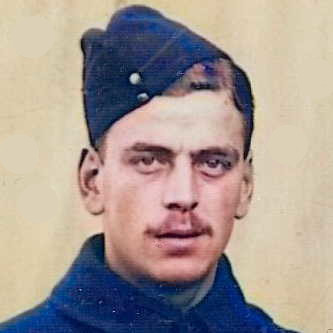

Photos and extra help courtesy of Nigel Johnson
From May through to September 2026, Andrew will be fulfilling his dream to hike the iconic Land’s End to John O’Groats! You are all warmly invited to follow Andrew’s epic journey on his Facebook page, “Andrew Beal LEJOG” https://www.facebook.com/profile.php?id=61577588795730
As Andrew hikes the 1,300+ miles, he will raise funds for the Ipswich War Memorial Project to help finance our future exhibitions and research of the brave Ipswich men and women who lost their lives in conflict. If you would like to make a small donation, please click on the link: https://gofund.me/5d4a50570
Thank you for your love and support. Andrew & Helen – I.W.M.P.
Born: 1st June 1894, at 2, Morfey’s Court, Curriers Lane, St. Mary at the Elms, Ipswich.
Baptised on the 22nd July 1894, at St. Mary Elms Church, Ipswich – family home at 2, Morfeys Court, Curriers Lane, Ipswich.
Died: 4th November 1918; age 24; KiA.
Residence: Morfey’s Court, Curriers Lane, Ipswich.
Occupation: Chauffeur.
Enlistment Details: Date: 11th April 1914; location: Tunbridge Wells, Kent; Lodgings – 36, Calvary Street, Tunbridge Wells; age: 20 years & 102 days; religion: CofE. Height: 5ft 5 3/4ins, fresh complexion, grey eyes & brown hair.
Service:
6th May 1916 – Promoted to Lance Corporal.
25th August 1916 – Misconduct – Stripped of Lance & Stripe for falling out of the ranks on the line of march in the field.
2nd February 1918 – Promoted to Lance Corporal.
12th April 1918 – Promoted to Corporal.
Wounded: 3rd September 1916, Gunshot Wound to Left Shoulder, taken to No. 4 Ambulance Train.
Rank: Corporal; Service Number: SD/470
Regiment: Royal Sussex Regiment, 9th Battalion (Lowther’s Lambs).
The body was discovered west of Wargnies le Petit at map reference 51G26d83. In December 1920, the body was exhumed, identified by the cross marking the grave and reburied at Cross Roads Cemetery.
Grave Reference:
II.C.15.
Fontaine-au-Bois,
France.
Relatives Notified & Address: Son of Frederick William & Maria Scrivener, of Morfey’s Court, Curriers Lane, Ipswich.
CENSUS
1901 2, Morfeys Court, Curriers Lane, Ipswich.
Frederick was 6 years old and living with his parents & siblings.
Frederick William Scrivener, 48, a Foundry Labourer, born Ipswich.
Maria Scrivener (nee Francis), 47, born St. Marylebone, London.
Marie Eleanor Scrivener, 23, a Cook – Domestic, born Ipswich.
Edith Victoria Scrivener, 11, born Ipswich.
Florence May Scrivener, 9, born Ipswich.
Lily Rose Scrivener, 4, born Ipswich.
Arthur Charles Scrivener, 7 months, born Ipswich.
1911 Fourth Avenue, Frinton-on-Sea, Essex.
Frederick was 16 years old, a House Boy – Domestic. He was 1 of 3 servants at the home of 50 year old, Sidney Edward Trench, a physician and surgeon – own account.
Frederick’s father, Frederick William Scrivener, died on the 15th August 1907 at his residence, Morfeys Court, Curriers’ Lane, Ipswich and was buried in Section E, Ipswich Old Cemetery.
Soldiers’ Effects to Maria Scrivener – mother.
On the 8th May 1919, Mrs Maria Scrivener signed and added ‘with many thanks’ for the return of Frederick’s personal property: Motor Driver’s Licence, Photo, Fountain Pen and Disc.
On the 18th September 1919, Maria Scrivener, of 4, Morfey’s Place, Curriers Lane, Ipswich, received the Commemorative Scroll.
On the 12th October 1921, Maria Scrivener received Frederick’s British War medal.
Frederick is also remembered on the handwritten war memorial at The Mission Free Church, Curriers Lane, Ipswich and at St. Mary Le Elm Church, Ipswich.
Royal Sussex Regiment, 9th Battalion
A family note from Nigel Johnson:
SD/470 Corporal Frederick John Scrivener, Royal Sussex Regiment
Born in 1894 into a poor family in Ipswich, Suffolk. He was the ninth of eleven children, four of whom died young. His father died in 1907. By the March 1911 Census, aged 163⁄4, he appears in Frinton-on-Sea in the service of Sidney Edward Tench (M.R.C.S.Eng., L.R.C.P.Lond.), a London-trained physician & surgeon. Three years later, when enlisting, he is a Chauffeur, possibly for the wealthy Mr Tench?
Five weeks after the declaration of war with Germany, on 11th September 1914, he signed up in Tunbridge Wells, Kent. Strangely, this was over one hundred miles from Frinton and a similar distance from his parents in Ipswich.
He was one of about 150 men from Rye and the surrounding areas to join the 1st Southdown Battalion between September 1914 and January 1915. The 2nd and 3rd Battalions were also raised; these respectively became known as the 11th, 12th, and 13th Battalions of the Royal Sussex Regiment. The three Southdown regiments were also known as “Lowther’s Lambs”, after Lt Colonel Claude Lowther, the then owner of Herstmonceux Castle and local MP, who raised them. They were all given the distinctive SD, South Downs, prefix to their regimental number.
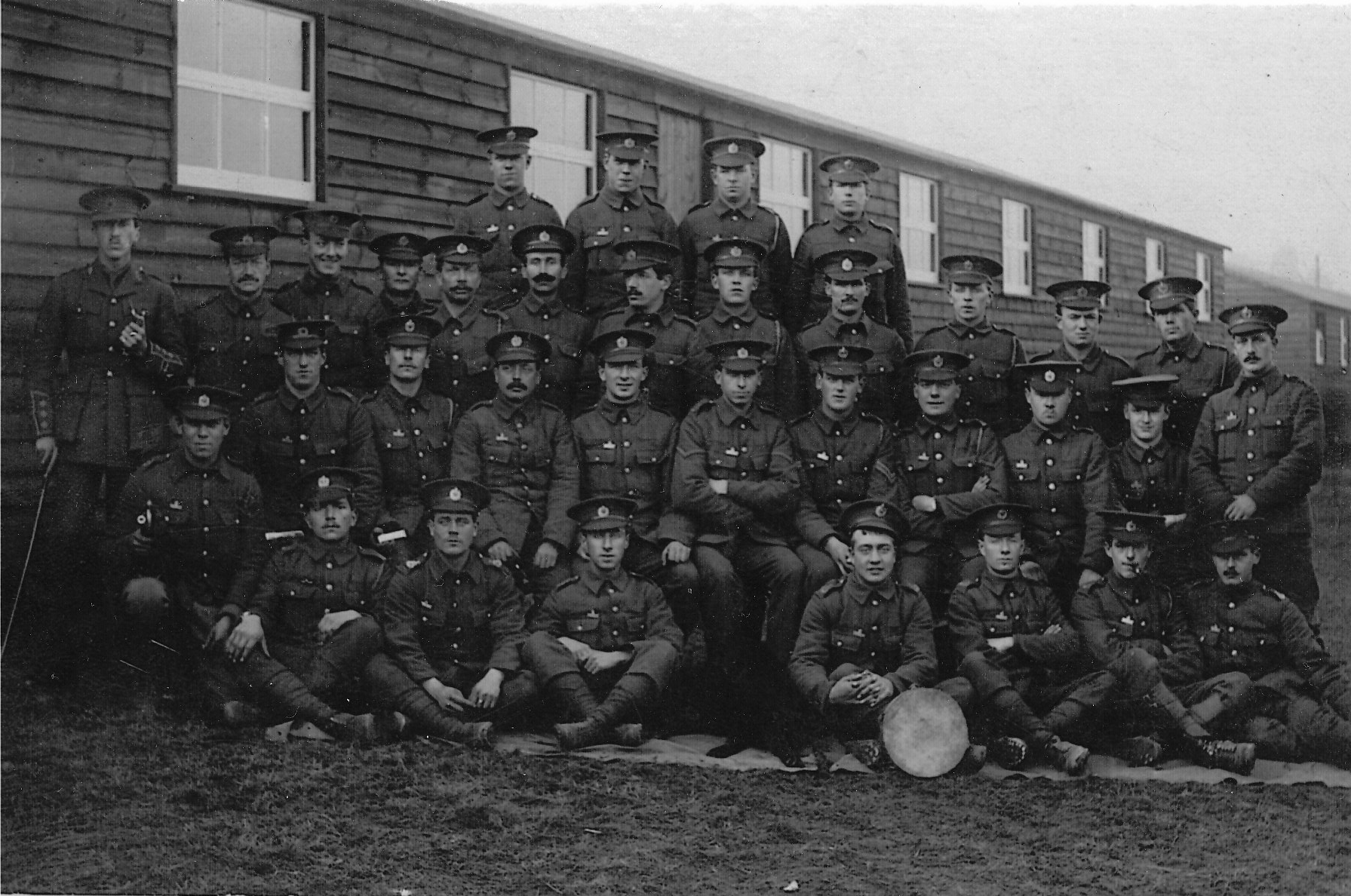
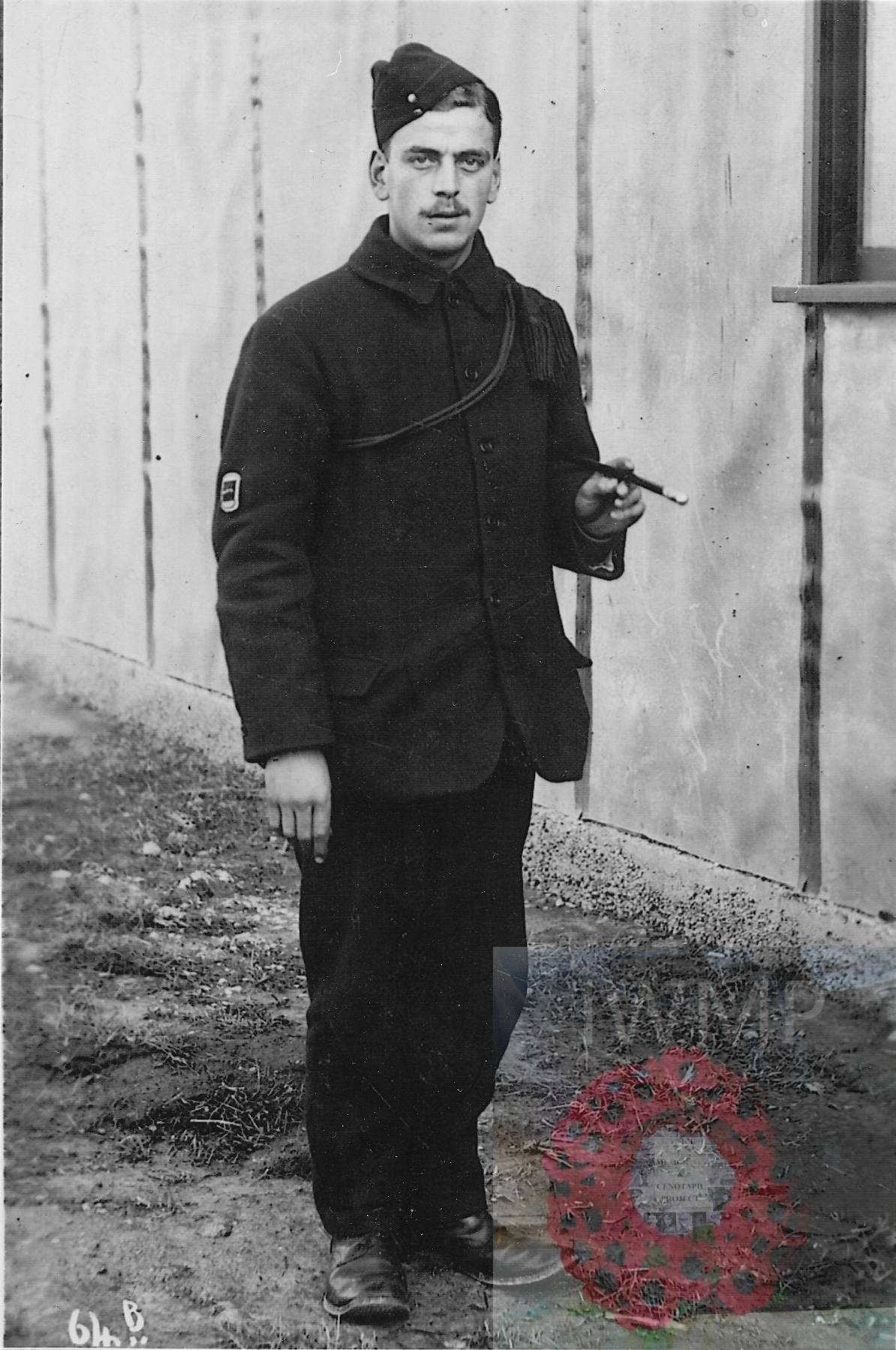
Initial training was at Cooden Camp, near Bexhill, before going to France early in March 1916. While at Cooden Camp, a photographer named George Chapman, who produced a whole series of pictures of the men and their activities (all similarly numbered), took him in the picture marked 64B.
The regimental picture was almost certainly taken at Cooden Camp before leaving for France. Curiously, the officer is sitting on the left, not central as was the norm. After three months in France, on the 6th May 1916, he was appointed Lance Corporal (unpaid). The main attack of the Battle of the Somme was launched on 1st July 1916 and was the worst day in the history of the British Army. The Sussex’s worst day had, however, taken place 24 hours earlier.
The battle at Ferme du Bois near Richebourg has largely passed out of popular memory. It is not mentioned in the official history of the War for Britain, and, coming a day before the infantry attack on the Somme, has become heavily overshadowed by the fighting there. The men of the 11th, 12th and 13th Southdowns Battalions that would lead the fighting there were unaware that their assault was a diversionary raid, aimed at drawing German forces away from the main offensive at the Somme. Their objective was the nearby salient, a bulge in the line, known as ‘The Boar’s Head’. Upon learning of the plans for battle, Colonel Grisewood, commander of the 11th Battalion, famously declared that ‘I am not sacrificing my men as cannon-fodder’. Grisewood was promptly relieved of his post. Grisewood had already lost one brother during the war. He would lose another at the Boar’s Head.
The 12th and 13th Battalions were given the responsibility to lead the attack with the 11th Battalion, having had their role reduced following Grisewood’s dismissal, tasked with providing carrying parties. This probably helped save FJS from injury.
At 3:05 am on 30 June 1916, they went over the top. The Germans had known they were coming for several days. As a result, the attack was a disaster. The 11th Battalion had sustained 116 casualties whilst supporting the attack. The 12th Battalion lost 429 men, either killed or wounded. The 13th Battalion, however, had been almost entirely destroyed, with over 800 men being killed, wounded or captured. In total, the three Southdowns Battalions suffered 366 killed and over 1000 wounded or taken prisoner. The majority of officers and Non-Commissioned Officers (NCOs) in these positions were among the casualties. This is often known as “The Day Sussex Died”.
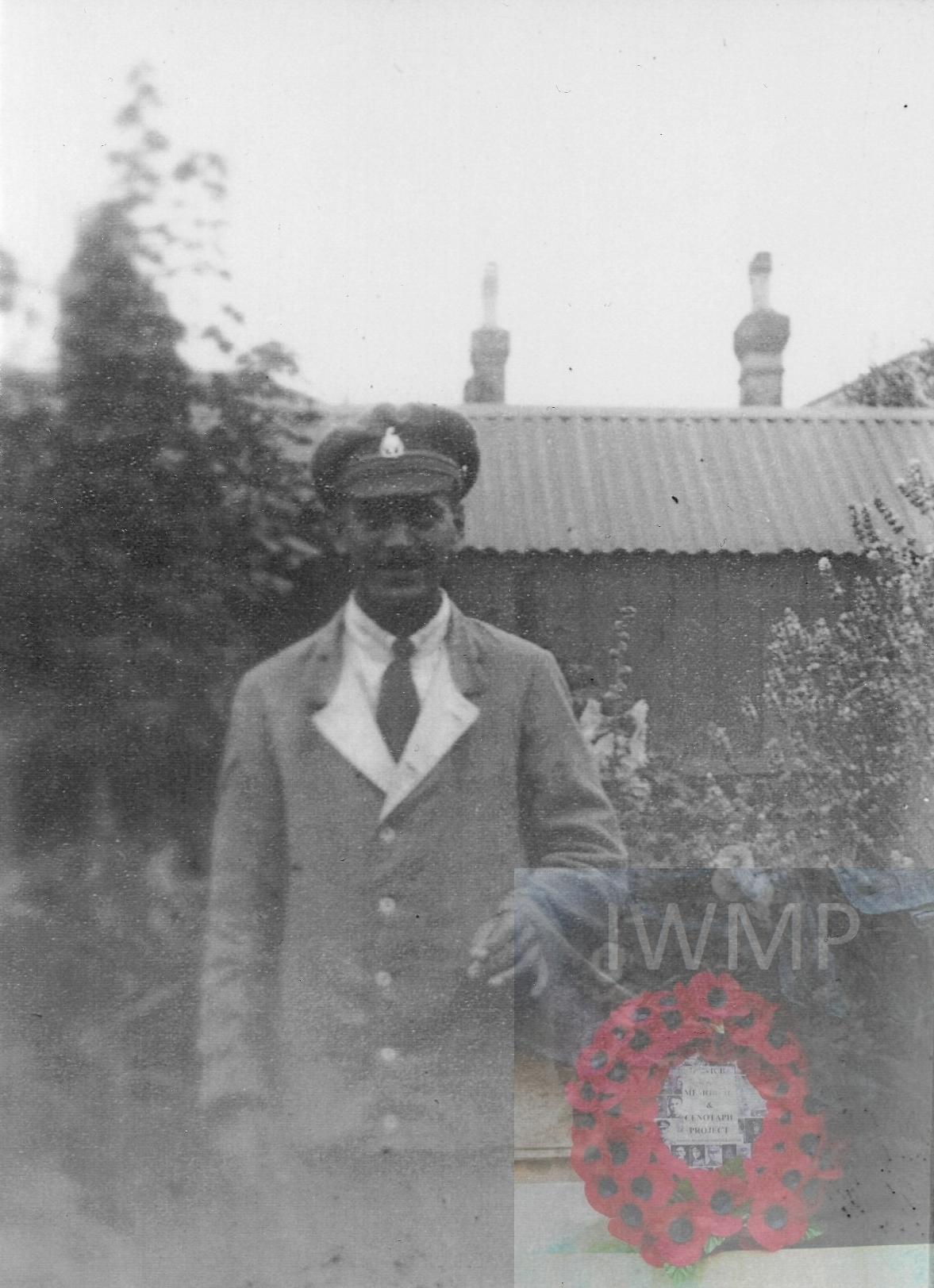 Almost two months later, he would be deprived of his Lance Corporal stripe for misconduct, “Falling out of the ranks on the line of march”. A week later, at 05:10hrs on Monday, 3rd September 1916, the 11th Royal Sussex (1st Southdown), alongside the 14th Hampshires, both of the 116th Brigade, 39th Division, attacked the German positions at Beaumont Hamel. They were supported by the sister Southdown Battalions, 12th (2nd) and 13th (3rd) Battalions. Initially, the attack went well, the first wave taking the enemy front line, but the second and third waves were caught in the German barrage brought down to counter the attack. The 11th Battalion had 111 men killed in the attack. FJS was one of the 160 wounded, receiving a gunshot to his left arm. He was taken to No.4 Ambulance Train (also known as the ‘white train’).
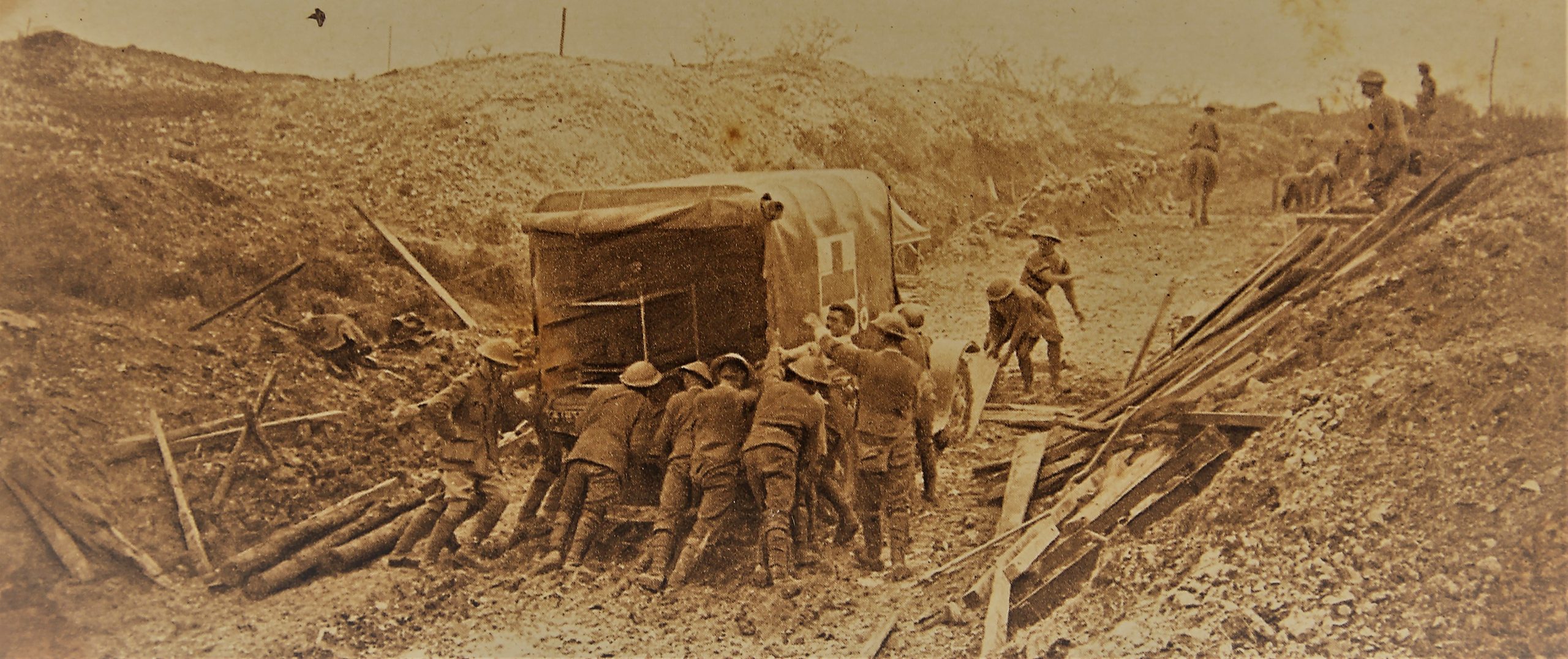
Poet Edmund Blunden was a Second Lieutenant in the 11th (1st South Downs) Royal Sussex. One of the men who lost his life in this engagement was SD/429 Sgt. F. A. Hoad. Blunden describes this incident in his poem “Pillbox”.
Eight months later, on 30th April 1917, while at Camp ‘M’ (possibly near the village of Glonville, France). He was involved in an incident and suffered a slipped cartilage of the left knee. A Military tribunal later deemed it an ‘Accident, not his fault’.
On 2nd May 1917, he was with the 134th Field Ambulance. Presumably for further treatment. Before returning to the 1st Birmingham War Hospital, back in the UK on 26th May 1917. A month later, he was sent to ”E’ Division Convalescent Hospital, Eastbourne. I assume it was here that the picture of him in his ‘Convalescent Blues’ was taken.
He was returned to service on 11th August 1917 and was posted to the 3rd (Reserve) Battalion, Royal Sussex Regiment, probably at Dover.
On 2nd February 1918, he was appointed Lance Corporal (paid) and the same day Acting Corporal (paid) with the comment “To complete establishment”.
On 1st April 1918, he returned to France, and on the 4th April, he was posted back to the 11th Battalion. His rank reverted to Private on his posting.
On 7th April 1918, he was posted to the 9th Battalion, Royal Sussex Regiment. Five days later, he was promoted to full Corporal. Known as the (second) Battle of the Sambre; according to the 9th Battalion Regimental diary, on 4th November 1918, they received orders “to take High Ground N. of WARGNIES le PETIT and WARGNIES le GRAND”. Zero hour was 05:30 hours, and progress would have been in a north easterly direction from the area of VILLERS POL
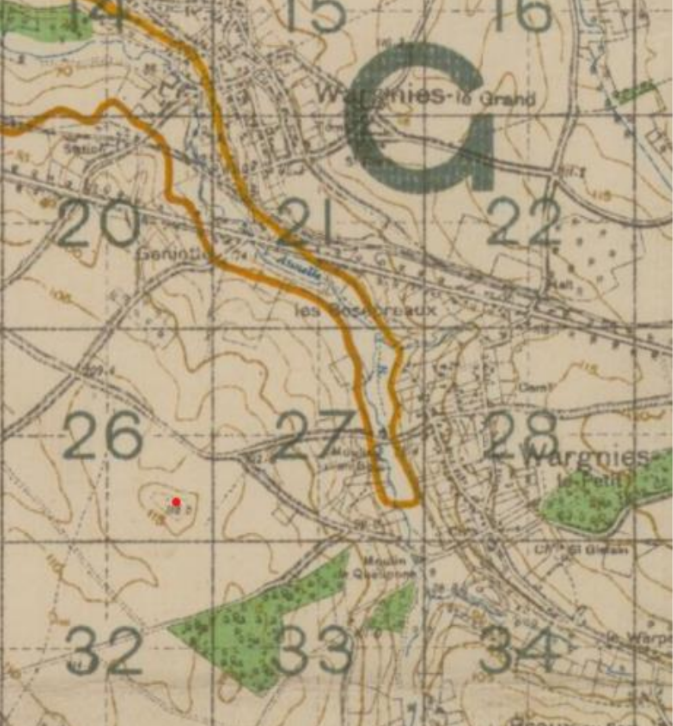
Almost exactly one week prior to the Armistice, he was killed in action. Presumably, he was buried near where he fell, on the high point at Map Ref: 51G26d83 (contour 118 on maps of the time), West of Wargnies le Petit. This looks down over the river L’Aunelle towards the Village on the opposite bank. He was laid here with seven other members of the 9th Battalion. GPS Coordinates would be roughly 50.291849, 3.657553
The Regimental diary goes on to say:-
The advance was successful, but ‘A’ and ‘B’Coys. were held up on the right by M.Gs. on both sides of the River until 11:00 hours when the enemy was forced to retire and these Coys. consolidated on the High ground W. WARGNIES le PETIT……during the afternoon. ‘D’Company pushed forward patrols under Lieut. P.H.Hill and 2/Lieut. W.ALDRIDGE through WARGNIES le PETIT at 16:00 hours, and finding no opposition, established touch with the 7th Northamptonshire Regt. E. of the Village at 17:30 hours.
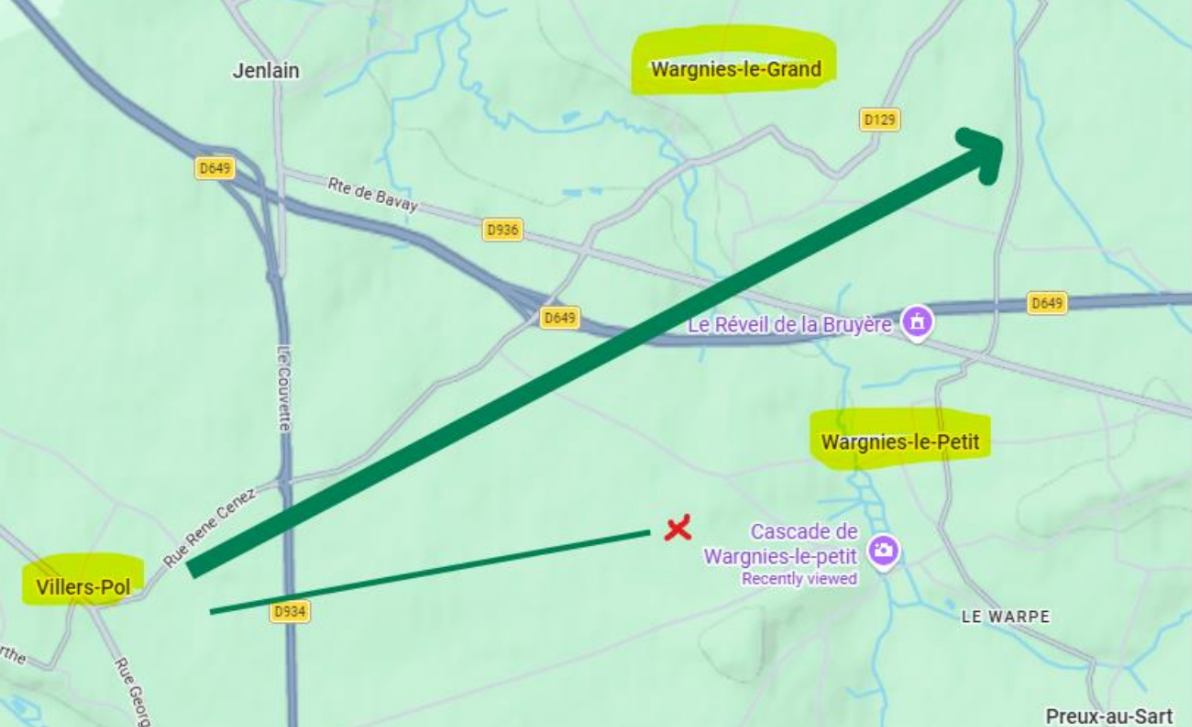
The current map of the area clearly indicates the Regimental objective and FJS’s route on the right flank, where the Machine Guns were reported.
Two kilometres outside Wargnies-le-Petit , ‘A’ and ‘B’ companies would have climbed up the incline and started
to descend the other side. Much as now, there would have been little or no natural cover.
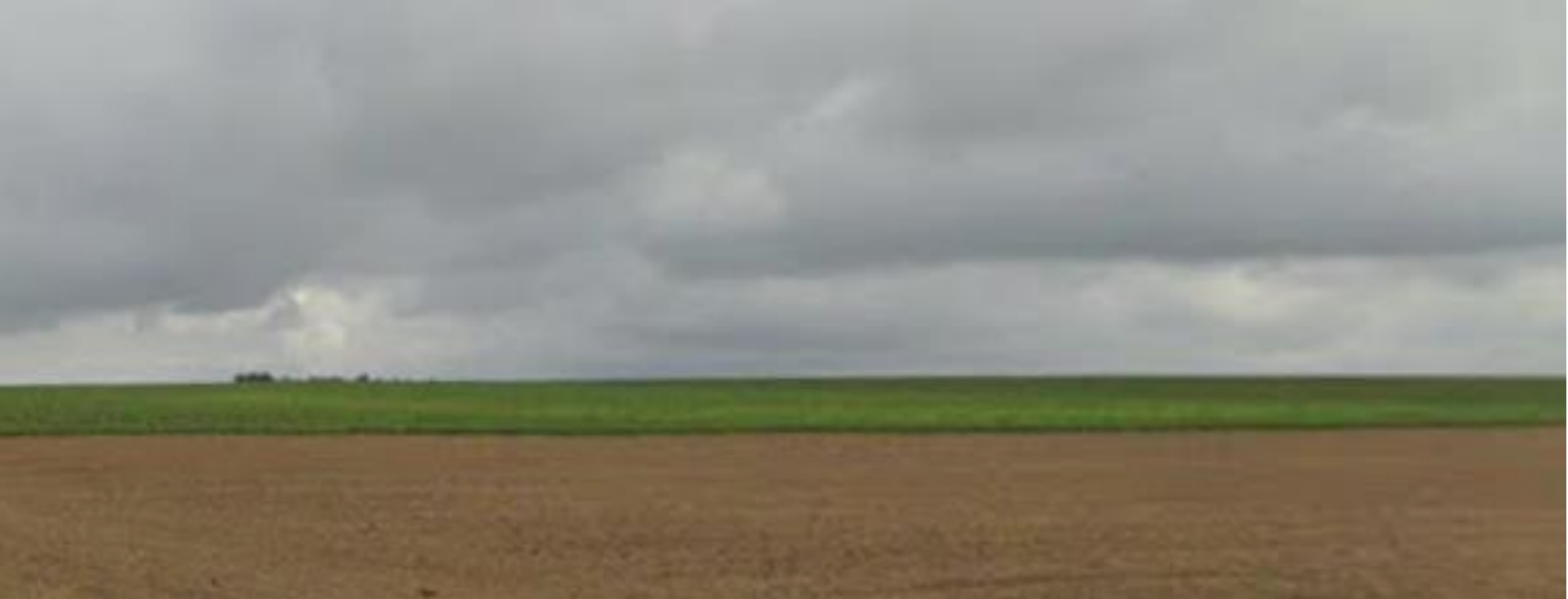
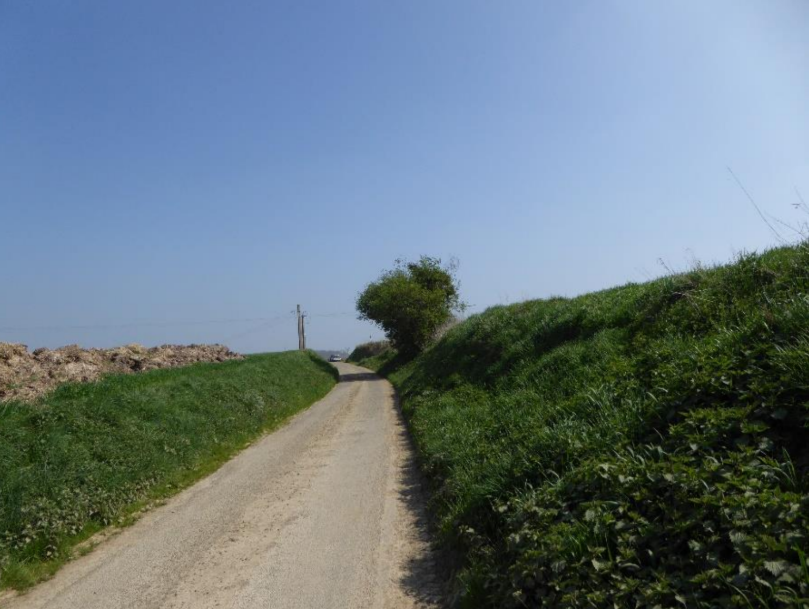 Ahead on the road they were approaching is sunken, with an incline down towards the river valley. Its high banks would have provided a perfect location for Germans Machine Guns to ambush the 9th coming over the hill, without being seen themselves. They could then retreat down the sheltered road towards the bridge and Wargnies-le-Petit. This picture is looking East. The car at the end of the road is sitting on the island where the road splits left and right, both going to alternative ends of Wargnies-le-Petit, less than a kilometre away. To the left (North), 1.5km across the fields is Wargnies-le-Grand. To the right is the field where the eight members of the 9th Battalion were buried and presumably killed in action.
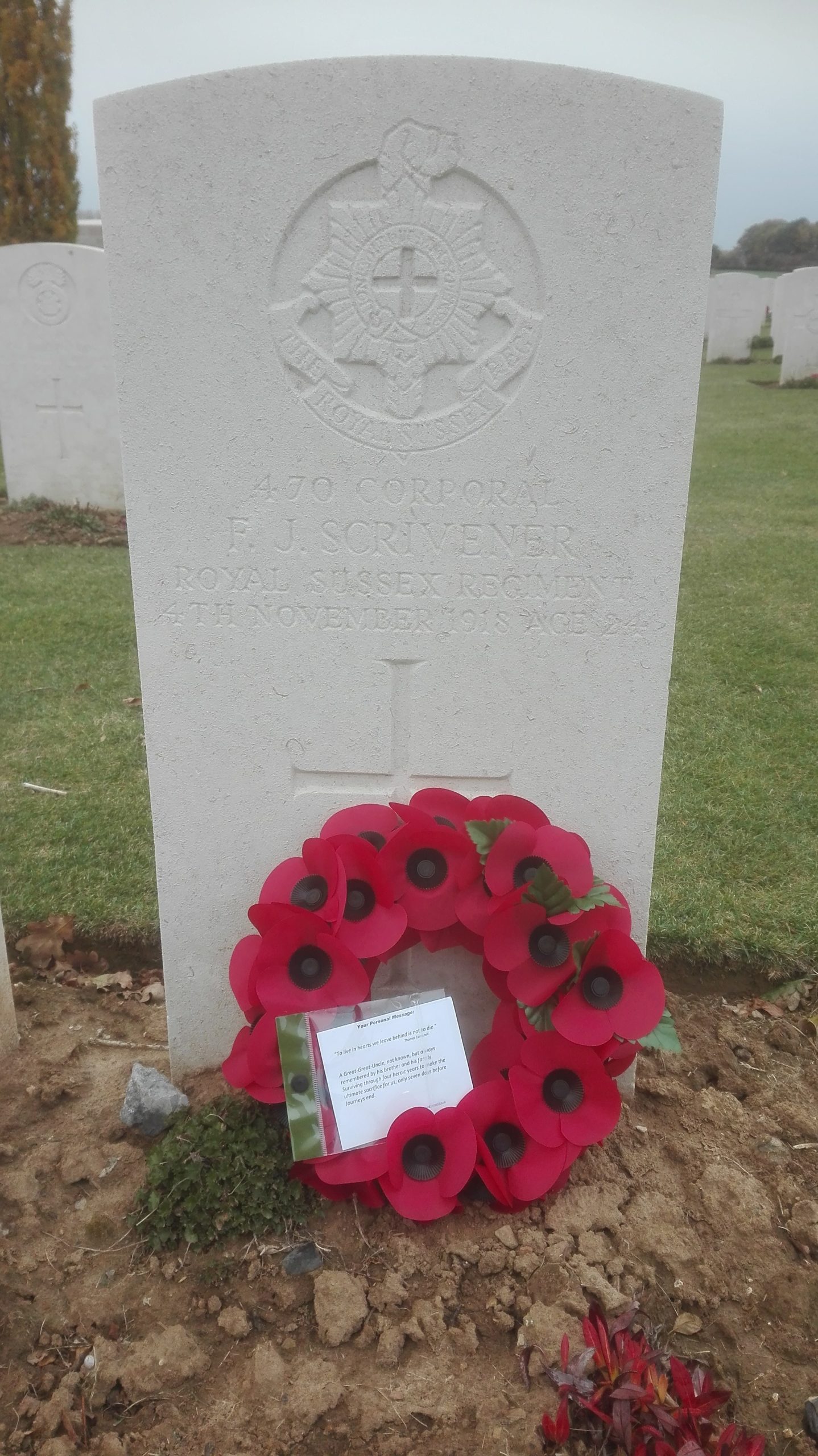
During December 1920, the consolidation of the war graves took place. The eight bodies, located by crosses marking their graves at Map Ref: 51G26d83, were exhumed and moved south 24km to Crossroads Cemetery at Fontaine au Bois, Nord in France, where they were reburied and lie to this day.
SD/470 Corporal Frederick John Scrivener, 9th Royal Sussex Regiment – Grave Reference II.C.15
4th November 2018
Summary: A soldier who enlisted in the 11th Royal Sussex at the very start of the war, becoming an NCO. He survived the Somme diversionary battle at Ferme du Bois, near Richebourg. Received a gunshot wound at Beaumont Hamel. Transferred to the 9th Battalion, was promoted to Corporal before being KIA in the (second) Battle of the Sambre, Aged 24. Just one week before the Armistice was declared.
Leave a Reply